

The teacher librarian must develop and review policies and procedures that support an effective library media program.
 My principal wants to know how I select books. I look in magazines and buy things. What do I say to him?
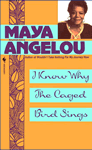
The mother of a student wants me to remove the book "I Know Why the Caged Bird Sings" from the shelf. It's popular, but should I take it off? She says she'll sue the school.
I just got a box of junky books from the wife of an administrator. I'd like to toss them, but I don't want to get in trouble.
This person would have a lot fewer problems if he or she had an established set of policies and procedures to follow. These questions could be addressed easily with selection, reconsideration, and gift policies.
 This section of the course contains the following related topics you'll want to investigate: Issues, Intellectual Property & Copyright, Intellectual Freedom, Rights of Library Users, Internet Access & Filtering Issues.
What are policies and procedures?
Policies and procedures guide the activities of the library media collection program.
Policies explain why the collection exists and what will be in it. A policy tends to address ideals and generalities.
Procedures explain how the policy will be implemented and who will be involved with the implementation. A procedure should be concrete and specific.
Normally, policies and procedures should be separate documents. Policies are usually published, while procedures are used for internal operations. For example, many website publish school policies.
Do policies really make a difference?
Policies can have a very real impact on your collection development practices. Without a policy you may face some of the situations:
- You are open to book censors.
- You may be cited on copyright infringement lawsuits.
- You could be accused of being biased in selection.
Having a written policy means that you're covered in most situations. However it also means that you need to adhere to your own policies. A policy can smooth a possible confrontation between you and a parent, staff member, or an administrator. People know that they are being treated fairly and equitably when there are policies in place. A policy should reflect the school's philosophy and provide clear focus for materials selection and deselection.
Like most documents, policies will evolve. However, they provide a frame of reference for decision making. Without a policy, you will have to reinvent the wheel with every concern or question. Policies also provide consistency over time. Although the collection and policies stay, the people may move on. Well-defined policies are of great help to a library media center newcomer. Finally, a policy can remove some of the subjective aspects of running a center.
What kinds of policies do I need?
Your policies may fall under one document or they may be divided into areas.
A collection development policy provides a broad overview of needs and priorities of the users and is based on the goals of the media program and school. This broad policy may include:
- a selection policy
- deselection policy
- reconsideration policy
- acquisition policy
A selection policy identifies the criteria by which materials are evaluated for inclusion in the collection and assigns responsibility for selection decisions. Sometimes this policy also encompasses the deselection policy and the reconsideration procedures.
A deselection policy describes the process of removing an item from the collection based on the selection policy.
A reconsideration policy describes the process followed in the event a person or group wishes to challenge the inclusion of an item in the collection.
An acquisition policy addresses the most efficient process for obtaining materials.
What is included in a collection development policy and manual?
Many people create a collection development manual that includes policies, procedures, and evolving documents demonstrating the living nature of the program.
You'll want to answer the following questions in your collection development policy:
- What is the purpose of your center?
- Who does your center serve?
- What is the focus of your center's programs?
- How are center materials selected and deselected?
- How will you deal with controversy?
Introduction. Your document should begin with an introduction that describes the use of the document, scope of the policy, audience, and need for the policy.
Statement of Philosophy and Goals. Your document should contain a statement of philosophy and goals for the program. There is nothing wrong with getting ideas from others. For example, many centers include statements from the American Library Association.
- Library Bill of Rights
- Freedom to Read Statement
- Freedom to View Statement
- Code of Ethics
- Libraries: An American Value
- Core Values Statements
This section should also provide an analysis of your patrons, collection, programs, and priorities.
Selection Policy. Your document should contain a selection policy that details specific selection criteria. It should answer the questions: how are materials selected and who will select them. It may also include a section on deselection and handling gifts or donations. Within this section you may also want to list the patrons who use the center and detail the materials you have available in the collection to meet their needs. Results from your needs assessment may also be incorporated into the evolving policy in the form of short and long term goals.
Reconsideration Policy. You center should have a policy and procedure regarding challenged materials.
To learn more about reconsideration policies, explore the selection of this course called Intellectual Freedom.
Acquisition Policy. Your acquisition policy should discuss how materials are acquired. It may list popular jobbers and guidelines for making purchasing decisions. You may also include your acquisition procedures including step-by-step procedures, lists of needs, and the current status of selected materials.
Evaluation Policy. You may also wish to discuss evaluation of the collection. How will the collection be maintained and evaluated?
Related Policies. In some cases, the library media center collaborates with other departments on documents related to information, communication, and technology. Be sure to include the following documents in your collection development manual:
- Acceptable Use of Networks Policy
- Acceptable Use of Internet and Filtering Policy
- Email Policy
- Copyright Guidelines
- Student Code of Conduct
What are some ideas for working with these documents?
Through experience, you'll find the most effective way to maintain and update collection development materials. The following guidelines will get you started:
- If committees are involved with making changes, be sure to keep a record of those people who were involved. In some cases, updated documents must be approved by the school board.
- Keep backup electronic and print copies of all documents.
- Keep copies of earlier versions of all documents to trace their history. Include the revision date on updated copies.
- Develop worksheets and forms needed to implement policies such as selection criteria checklists and reconsideration forms.
Is an up-to-date policy really necessary?
A "living" document that evolves as you and your program change is extremely useful. It's always up-to-date and ready for decision making. However your policy is worthless if it's stored in a drawer after being written. If it's not updated, it will probably need to be recreated from scratch somewhere down the road. It's much easier to constantly keep it up-to-date. Keep all materials a three-ring binder for easy access by the patrons and staff. However keep the master files in a secure network electronic folder.
People don't think they need a collection development policy until they face one of the questions posed at the beginning of this section. You're better safe, than sorry.
Check Your Understanding
 Information Power - Information Access and Delivery: Principle 7. The information policies, procedures, and practices of the library media program reflect legal guidelines and professional ethics. (p. 83, 97)
Examine sample collection development policies. Identify the strengths and weaknesses in each policy. Brainstorm additional items that should be included. Describe elements that could be added to make a policy a "living" document.
Make It Real
 Explore the many policy resources on the Internet.
Create a personal pathfinder of materials that can be used as you design your own materials.
Read More About It
Writing Policies and Procedures
Johnson, Debbie and McCaskill, Sarah (Fall 2002). Policies and Procedures Manual Web Guide
http://ths.sad44.org/library/..
Developing a policies and procedures manual for your media center. Has good section on collection assessment
Policies and Procedures Impacting School Library Media Centers from Washington Library Media Association
http://www.wlma.org/WaLibraries/policyconcepts.htm
Workbook for Selection Policy Writing from American Library Association
http://www.ala.org/alaorg/oif/workbook_selection.html
Writing a Collection Development Policy from Idaho State University
http://www.lili.org/forlibs/ce/able/course1/01CD1.htm
Collection Development Policies
Collection Development Policy of the Herbst Library, Urban School of San Francisco
http://inside.urbanschool.org/library/Pages/colldev.html
Collection Development and Materials Selection Policy at Tulsa Public Schools Library Media Centers
http://www.tulsaschools.org/,,,%5D.htm
Collection Development and Mission Statements from Apponequet Regional High School Library, MA http://users.rcn.com/libra/mission.html
Collection Development Policy at Wilmington School District, VT
http://www.dves.k12.vt.us/html/libpol.html
Collection Development Policy at Palmerston District Primary School, Australia
http://www.palmdps.act.edu.au/resource_centre/policies/collection_dvpt.htm
LMC Policies from Lindbergh School District, MO http://www2.lindbergh.k12.mo.us/lmsc/index_files/page0003.htm
Model Policy from Iowa Association of School Librarians
http://www.iema-ia.org/IEMA115.html
School Library Policies from California Department of Education
http://www.cde.ca.gov/ci/cr/lb/policies.asp
Selection Policies
Book and Audio Visual Selection at Portage la Prairie School Division, Manitoba, Canada
http://www.plpsd.mb.ca/division/bookand.htm
Book Selection Policy for Milbank High School, SD
http://www.milbank.k12.sd.us/jschwab/selection_policy.htm
Materials Selection Policy at Germantown Academy, PA
http://www.ga.k12.pa.us/academics/library/selectionUS.htm
Materials Selection Policy from Media Technology Services at Groton Public Schools, CT
http://groton.k12.ct.us/mts/matselect.htm
Materials Selection Policy for School Library Instructional Technology Centers from Dept. of Education, State of Hawaii, Office of Instructional Services
http://sls.k12.hi.us/selection.html
Media Center Materials Selection Policy at Bowling Green, OH http://winslo.state.oh.us/publib/material-bg.html
Selection Criteria for School Library Media Center Collections from Baltimore County Public Schools
http://www.bcps.org/offices/lis/office/admin/selection.html
School library media specialists are responsible for the review, evaluation, and selection of the school library media collection. They are guided by the system-level selection policy that embodies the philosophy and procedures set forth in national, state, and county documents. Library media specialists work cooperatively with administrators and teachers to provide resources which represent diverse points of view, stimulate growth in thinking skills, and promote the overall educational program.
Selection Criteria for School Library Media Center Collections, Baltimore County Public Schools, MD
http://www.bcps.org/offices/lis/office/admin/selection.html
Selection Policy for School Library Materials at School District of Philadelphia
http://www.libraries.phila.k12.pa.us/misc/selection-policy.html
Challenged Materials Policy
Challenged Materials Policy, Rogers High School, AR
http://www.rogers.k12.ar.us/users/mcook/challenge.html
Acceptable Use of Internet and Networks
Minkel, Walter (Mar. 2001). Chat Room-Policy Discussion. School Library Journal.
http://www.schoollibraryjournal.com/articles/CA153101
Smith, Alastair. Criteria for Evaluation of Internet Information Resources. Department of Library and Information Studies, New Zealand.
http://www.vuw.ac.nz/staff/alastair_smith/evaln/
This is a "toolbox" of criteria that enable Internet information sources to be evaluated for use in libraries, e.g. for inclusion in resource guides, and helping users evaluate information found.
Library Media Program Handbooks
Beyond Proficiency: Essentials of a Distinguished Library Media Program from Kentucky Department of Education
http://www.education.ky.gov/...Media/Beyond+Proficiency.htm
Catalyst: Setting the Standards for Student Learning Through School Library Media Centers (2002), South Carolina
http://www.myscschools.com/offices/tech/ms/lms/Catalyst_2002.pdf
Elementary Librarian Handbook from Puyallup Public Schools, Washington
http://www.puyallup.k12.wa.us/intranet/library/handbook/
Handbook for Library Media Specialists and Administrators from Howard County Public School System, Maryland
http://www.howard.k12.md.us:16080/met/media/handbook/index.htm
Indiana Learns: Increasing Indiana Student Achievement through Library Media Technology Programs
http://www.indianalearns.org/
IMPACT: Guidelines for School Library Media and Instructional Technology Programs (2000). North Carolina Department of Public Instruction.
http://www.ncwiseowl.org/impact.htm
Library Media Services Handbook from Chesterfield County Public Schools, Virginia
http://chesterfield.k12.va.us/...Library_Media_Handbook.html
Library Procedures Manual from Georgetown Independent School District, Texas
http://www.georgetownisd.org/programs/support/libmanual/index.htm
Reference includes all relevant policy and guidelines for library services.
Maine Library Facilities Handbook from the Maine Association of School Libraries (MASL)
http://www.maslibraries.org/about/facilities/handbook.html
Library media programs are continually changing, so facilities must be designed to be as flexible as possible in order to meet future needs.
Online Media Handbook (1999) from School District of Hillsborough County, FL
http://apps.sdhc.k12.fl.us/...mediahandbook/toc.htm
Designed to assist media specialists who have the responsibility for selection, acquisition, and utilization of educational media.
School Library Handbook (1999/2001) from School District of Philadelphia
http://www.libraries.phila.k12.pa.us/handbook/index.html
School Library Media Standards Handbook from Missouri Department of Elementary and Secondary Education
http://www.dese.state.mo.us/divimprove/curriculum/library/
School Library Media Standards Handbook (Nov. 2003) from Missouri Department of Elementary and Secondary Education
http://www.dese.state.mo.us/divimprove/curriculum/library/
Texas School Libraries: Standards, Resources, Services, and Students’ Performance from Texas State Library and Archives Commission
http://www.tsl.state.tx.us/ld/pubs/schlibsurvey/index.html
Wendell, Laura (June 1998). Libraries for All! : How to Start and Run a Basic Library. Libraries for All! United Nations Educational, Scientific and Cultural Organization.
http://worldlibraries.org/publications/lfa/1cover.htm
You are the Key: Handbook for Geogia School Library Media Specialists from Geogia Library Media Association (GLMA)
http://www.glma-inc.org/handbook_toc.htm or
http://www.clayton.k12.ga.us/...index.htm